Filed under: Bing, Google, Internet Marketing, Search Engines, SEO 101 | Tags: Bing, bing travel, chrome os, Google, informationweek, microsoft, search engine wars, search monopoly
Yesterday, I posted about some confusion regarding a mysterious link in my Gmail header that did an “ask jeeves search” inquiry in Bing. While I was doing this sleuthing around, I found some other interesting search results that I thought deserved their own separate blog post.
What I found makes it look like there’s a silent war going on between the competing search engines. I tried doing a search on Bing for “google” and got this interesting result:
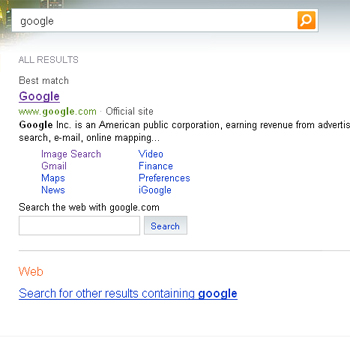
The description reads, “Google Inc. is an American public corporation, earning revenue from advertising related to its Internet search, e-mail, online mapping…” It makes Google sound like their biggest priority is making money from ads, which is true in a sense, but they can only make money from ads by retaining searchers, and they only do that by being a great search engine. The term “search engine” isn’t even in this description, although they do note that the advertising is “related to its Internet search”.
Granted, this is the official encyclopedia definition for Google, so maybe it is warranted. However, that is the definition for Google as a company, not Google’s search engine. The encyclopedia entry for Google search reads, “Google search is a web search engine owned by Google Inc. and is the most-used search engine on the Web.” I wonder why they wouldn’t want to use that definition? Maybe because it advertises a clearly more popular search engine than Bing? Hmm.
But then I thought, that’s not really playing fair. I’m not much looking at other definitions, am I? So I did a Google search for “google” to see what they define themselves as.

I searched on Google for the popular search engine.
Well, since google.com doesn’t have a meta description, it just pulls the text from the site. That’s pretty boring. But wait, what’s that news story being displayed? It’s a recent article from Dave Methvin on InformationWeek’s weblog entitled, “Why I’m Dropping Bing for Google“. If you repeat the search today you won’t see it, so I’m positive that this was just sheer coincidence. I still got a good laugh out of it, though!
It seemed only fair to repeat the treatment for Bing. I then did a Bing search for “bing”.

I searched Bing for themselves.
A much more flattering description for Bing! But what’s up with those news results? Even Bing assumes you aren’t really looking for Bing. Today the news is all related to Bing the search engine, in all fairness. This begs the question: how does a Google search for “bing” turn out?

I just about died laughing when I saw this. Again, none of this may be intentional, but I sure got a good ride off of it! They show Bing’s description for themselves, but a cached link for Bing Travel makes it look like it is out of service for the moment – although when you actually visit Bing Travel they seem to be running. The results are still like this today, which makes me wonder why Google has this page cached and not Bing local or Images. Is Bing Travel really that popular, or is this another great joke from Google?
And then of course, Google announced the development of their new operating system, Google Chrome OS. Is this another stab at Bing from Google, or just another coincidence on the pile? If you want to read more on this topic, I wrote an article on the SEO 101 blog entitled, “Google ‘Pulls a Bing’ by Nudging Into Microsoft’s OS Monopoly“. Enjoy!
What do you think? Have you seen anything strange from these two internet giants? I’d love to hear your thoughts!
Filed under: Bing, Google, Internet Marketing, Search Engines | Tags: ask jeeves, ask.com, Bing, bing vs google, Google, optimization for bing, seo, SEO for bing
Something bizarre happened while I was checking my Gmail today. On my top marquee, there was what seemed to be a message from Gmail telling me to do an “Ask Jeeves Search” on Bing. The full message was, “Let Us Help You Find The Answers. Try Bing™ Today. http://www.Bing.com”. I’m 90% sure it was just a paid ad, but why “Ask Jeeves Search” for the anchor text?

WTF? I couldn’t figure it out. My curiosity got the better of me. So I clicked on the link, and it did a search for “ask jeeves search” in Bing.

The results weren’t shocking. Ask.com was the first result, as it should have been. The other results weren’t too far off. You get pretty much the same thing on Google. So I asked myself, what’s the point of this? And did another search, but this time for “ask jeeves search engine”, because that was one of the related searches in Bing.

It’s basically the same thing, but it has an Ask.com search bar, which admittedly is kinda handy. But wait, why wasn’t it on the “ask jeeves search” query? I feel a little denied. If the Gmail link was a Bing ad, why not link to the query with the search engine? Well, why promote another search engine in the first place?
I decided to try something else. I searched for just “ask jeeves”.

What? Now all my other search results are hidden! Yeah, they’re just behind a link below the ask.com listing, but if I were looking for the more archaic askjeeves.com I would be horribly confused.
I don’t know if Google is trying to point something out about Bing, but if they are, I’m missing the point. I am a little confused, however, about why you would get such different results for what is essentially the same search.
This led to further searches on Google and Bing that turned out very interesting results – are Bing and Google having a silent war on each other?! Stay tuned for the exciting story in “Part 2: The Silent War in Searches?”
Filed under: Google, Internet Marketing, Link Building 101, Search Engines, web marketing | Tags: algebra, Google, link juice, math, matt cutts, nofollow attribute, nofollowed, pagerank sculpting, PR sculpt
Recently, Matt Cutts released a new blog entry on PageRank sculpting and the nofollow attribute that was loudly received by the general public, although the actual effects of this information on the SEO world may remain minimal. I say “remain” because apparently the changes announced had already been in place for more than a year, and no one had noticed.
I’ve seen a lot of really great pictures and graphs about this subject since the outbreak. I especially like the pagerank flow blog entry from The Google Cache. It’s a really great interpretation for people who think visually.
Unfortunately, I am one of those people who think in math terms. (Here’s lookin’ at you, Randall Munroe!) That being said, here’s my interpretation, through basic algebraic terms, of the “new” PageRank flow, with step-by-step explanations.
Before the Nofollow Attribute:
PR ÷ L = LJ
This is pretty straightforward. Your pagerank divided by the number of links you have is the amount of “link juice” being passed through your links. For example, if you have a page with a pagerank of 6 and you have 3 links, you’ll give 2 points of link juice to each page that you linked to. (Compare: 6 ÷ 3 = 2)
(PR ÷ L) X L = TLJ OR LJ X L = TLJ, PR = TLJ
This equation is just looking at the total link juice being passed by the page. You’ll see why I’m looking at this in a moment. Without nofollow or any other stipulations, you can simply multiply the individual link juice by the number of links on the page to find the total link juice, and it should equal the pagerank. Please keep in mind with all of this that there are other factors that effect pagerank (such as placement of a link in the content of a page), but my basic algebra can only portray so much1. (Compare: (6 ÷ 3) X 3 = 6 OR 2 X 3 = 6)
With Nofollow Attribute:
PR ÷ (L – NF) = LJ
And this is why the nofollow attribute was such a boon to optimizers. Here, you can increase your link juice going to each link by nofollowing links that aren’t as important (such as your contact page). In our example, let’s say you nofollowed one of three links on a page with a pagerank of 6. In this case, you would be giving 3 points of link juice to two links (your more important ones) instead of two points of link juice to three (including your contact page, which you may think doesn’t need juice). (Compare: 6 ÷ (3 – 1) = 3)
[PR ÷ (L – NF)] X (L – NF) = TLJ, PR = TLJ
Here we can see that there’s a very different mechanism for discerning the total link juice of a page – but the total link juice is still the same as the pagerank. This is the essence of pagerank sculpting, in that you’re working with the total amount of link juice available but moving it to the pages you want. (Compare: [6 ÷ (3 – 1)] X (3 – 1) = 6)
With “New” Regulations:
PR ÷ L = LJ
Look familiar? It’s the same as before the nofollow attribute. Each link gets a set amount of link juice based on the number of links on the page (and various other factors), regardless of the nofollow attribute. The nofollow attribute still blocks link juice from flowing through pages, but it doesn’t factor into how much link juice is being passed by individual links. This is the main peeve of optimizers with the “new” rules – imagine you have a lot of policy pages, about us pages and contact pages linked to in your content (after all, many companies really want people to navigate to that contact us page) that were all nofollowed, but now those links are taking away link juice from other links to more quality pages. What optimizers need to remember is that this change has been in place for over a year, and nobody noticed – not even the good ‘ol folks at Search Engine Watch. (Compare: 6 ÷ 3 = 2)
(PR ÷ L) X L – (LJ X NF) = TLJ
You might notice that the front end of this equation, (PR ÷ L) X L, is the same as the equation before nofollow for the total link juice. This is basically your total link juice, minus the link juice that would have gone to nofollow links.
This is actually very important to my ideas about pagerank sculpting. I believe that because of this kind of idea, there’s a false fear in SEO about ‘lost link juice’ (because in this equation, PR ≤ TLJ, or pagerank is less than or equal to total link juice). There are a lot of metaphors out right now about juice being spilled on the floor (we could get into other, more biblical connotations, but we won’t) but I think the point is that we need to make quality content to really spread some good link juice. If you start with a PR of 2, it doesn’t really matter if you’re able to sculpt with nofollow, because frankly, your links weren’t worth much anyway. Which brings me to my next point.
Remember: Google’s Job is to Get the Best Results
We have to remember that Google’s job is to get every search engine user the best results for their search. They don’t want your crappy website to outrank quality resources just because you know how to sculpt some pagerank. If you really want your website to outrank competitors for your keyword, you’ll have to make a better website than your competitors. Yeah, it makes life harder for SEOs, but I really don’t want pictures of a nude Paris Hilton when I’m trying to plan my Parisian honeymoon.
1“Please excuse the crudity of this model, I didn’t have time to build it to scale or to paint it.” Christopher Lloyd in Back to the Future
Filed under: Bing, Google, Internet Marketing, Search Engines, web marketing | Tags: Bing, Google, google analytics, optimization for bing, search engine, search engine monopoly, SEO for bing, yahoo
Let me say this first: I don’t think Bing is ultimately going to rival Google as the most used search engine. I do, however, think that Bing has some interesting ideas and has made a strong start in the market. ComScore released data for Bing’s first week, and it looks like they have a great boost in users willing to switch to Bing from other search engines – at least, for now. According to Mike Hurt, comScore senior vice president, “The ultimate performance of Bing depends on the extent to which it generates more trial through its extensive launch campaign and whether it retains those trial users.”
In an interview with Fox Business (an interesting watch, I highly recommend it) in which Bing was discussed, Eric Schmidt stated that, “Well [Bing is] not the first entry from Microsoft, they do this about once a year. And from Bing’s perspective, they have a bunch of new ideas, and there’s some things that are missing. … Google is literally one click away. Since Bing’s arrival, for example, people have been switching to try it, and then they switch back. It is very easy to switch from one to the other.” I think he’s right to be secure about Google’s future. Schmidt goes on to talk about how Google has a different strategy than that of Yahoo or Bing, and I agree with him here as well.
I think that Bing poses a great “what if” to the SEO industry, and I think it’s a best practice to be prepared for what search engines may come. Bing does have a very different strategy, and it will make for a very different optimization strategy if Bing should ever succeed Google. Bing is indeed already outpacing Yahoo results in Google Analytics for many developers’ websites.
One thing that is different about Bing is that they list a trio of results for related keywords, as well as your original keywords. In my example search for the term “intraocular lens,” websites are not only competing for top results for “intraocular lens,” but also “Types of Intraocular Lens,” “Intraocular Lens Cost,” “Intraocular Lens Procedure,” etc. Sites that effectively target all these keywords will appear multiple times in one page, whereas sites who normally appear 4th or lower for these keywords are practically invisible.
Something else I noticed about Bing that could pose an interesting possibility for optimizers is that Bing can refer users to other pages within your site in a much cleaner, somewhat more consistent format than Google. Using the same example, I hovered over a link to allaboutvision.com on the right side of the screen.

See those “Also on this page” links? Those are links on your page that have been nicely extracted and bulleted for users to click through. I believe this is why many users are seeing an increase in Bing referrals over Bing organic results in Analytics. Those clicks count as referrals, whereas the organic results count as, well, organic results. This speaks worlds for how a great internal linking structure could become very important (or rather, more important than it already is) if search engines that practice algorithms like Bing’s come into play.
What do you think of Bing? How is it showing up in your Analytics? I’d love to hear about it!
Filed under: Internet Marketing, web marketing | Tags: Internet Marketing, link building, marketing, seo, star trek, web marketing
Running an internet marketing company is just like running an intergalactic spaceship, I’m sure. It takes a savvy captain and a steely crew to navigate through the various obstacles of space and time! Who in your company has a good mind for engineering? Who can kick everybody’s butt into line? Who is the most logical? Next time you go to reconsider your structure, keep these characters in mind…

A lovely image of the Mona Lisa, in the famous red shirt of Star Trek.
Red Shirts. These, of course, would be your interns.
You may not always realize it, but they are invaluable to have around! Who else going to do the dirty work when the captain and science officer are busy? Give these guys the tasks that need to be done and can be done by the average crewman, but would otherwise be a waste of someone’s time. Try not to bore them to death (Er…), but keep in mind that they aren’t yet experts in their field – if you give them something really difficult, like, say, going to the surface with your top talent, something may go horribly wrong.
Sure, they may not last very long, but they keep the story moving forward and ideally they will get the job done while they’re there. That being said, if you give them projects that take a long time to complete (like a year or two) make sure to track it so that if they KO on you, the new red shirt can pick up where they left off.

Lieutenant Uhura, photo courtesy of fromchicago on Flickr.com.
Uhura. She represents office management and your receptionist.
Office management is important to your company because they maintain the day-to-day communications and operations on board your ship. While everybody else is busy running the ship, office management gets to play mommy, making sure the crew has supplies and are keeping good relations with other members.
Your receptionist is in charge of picking up signals and transferring them to the correct department. He or she will also help keep tabs on the staff and do other odd errands, like planning office parties, or seducing the enemy with his(?) or her fan dance. A good receptionist will keep everything in order and running smoothly – a great receptionist will be smart, savvy about public relations and good with a phaser.

Awesome MiniMates of Chekov and Sulu. Courtesy of kingkong21 on Flickr.com.
Chekov and Sulu. These fellows represent your sales staff.
As your navigators and helmsmen, their sole purpose is to continually help move the ship forward. That’s what your sales staff should do – act toward goals that might help move your company forward, either by bringing on an alliance with new life forms and new civilizations (clients and syndications) or by boldly going where no man has gone before (conferences)!
They need to not only have a good sense of the ship’s headings, but they also need to be good in the field. Your sales staff should go out to the surface armed with the tools they need to make it – make sure they have every proof with them, either in their heads or in their hands, that your Enterprise is the way to go for prospective clients.

Montgomery Scott! Image courtesy of daughter of chaucer on Flickr.com.
Scotty. He represents your IT, programming and design staff.
Scotty is basically responsible for maintaining the ship and all its internal functions. To me, he is the epitome of IT. He has to run the ship without always having the right materials (“I need more dilithium crystals!”) and sometimes without enough time or understanding from the rest of the crew to get the job done. IT staff members might take a note from Scotty’s book and always give themselves more time than they think they need for projects (although maybe not necessarily in multiples of four).
Whereas programming and design may relate more to your product than your ship, I believe this is still related to Scotty in that he is also responsible for internal functions on the ship – making sure that all databases are functioning properly and designed to do what they’re supposed to. (If you want to keep an eye out on another great Scott, follow @great_scott on Twitter!)

DeForest Kelley as Bones! Image from skookums on Flickr.com.
Bones. This is your SEO staff!
As chief medical officer, Bones doesn’t have quite as direct a metaphor to SEO, but here’s my reasoning: what Bones does for the Enterprise, more importantly than take care of the ill, is serve as one of the primary tacticians for the captain. Who is always exploring the surface of a strange planet and has to make some incredible plan to get the Enterprise safely back on track? The captain, his science officer and Bones!
Your SEO team needs to be able to work with analytics and writing (your science officer) to come up with a plan on how to best get your ship to where it needs to be… or your websites to the top listing in search engines. Whatever. They may not always get along well with analytics and writing (“That green-blooded SOB!”) but in the end, their relationship will be crucial to the success of the ship.

Leonard Nimoy as Spock in the early days of the show. Courtesy of skookums on Flickr.com.
Spock. He represents your research, analysis and writing departments.
As your science officer, Spock is responsible for looking at the data available and determining the best course of action. He’ll be the first to tell you if something doesn’t make sense (“That is not logical.”) and he is crucial to your positioning tactics and absolutely necessary to the development of content.
With the accumulation of data goes the accumulation of content. It is important that you take the research and data that you have an turn it into great content for your websites, blogs and social media sites. This is not limited to just words for your sites – images, video, graphs, and other various media will help develop your site into a real force to be reckoned with.

William Shatner as Kirk, being awesome. Courtesy of idoen on Flickr.com.
Captain Kirk. He represents your CEO! (And maybe everybody?)
What is a company without its fearless leader? A good leader must be dedicated and resilient, with a strong focus on his or her goals and values. Of course, every leader has a hubris. Just as Kirk may have been frequently overruled by his passions, the leader of a strong web marketing company must not be overruled by what he thinks the company should be, but rather driven by what the company needs to be to meet the demands of its market.
I also like to think of everyone as being their own Kirk aboard the Enterprise – and not just because I really want to be Kirk. Everyone is responsible for holding themselves and the people they rely on accountable. If nobody stands up and takes on their responsibilities to the next level, the ship might be moving – but it won’t actually be going anywhere.
Some information courtesy of:
StarTrek.com: Library.
What do you think? How does The Next Generation fit into this, is your Captain a Kirk or Picard? What about Star Wars? I’d love to hear your comments!
Filed under: Link Building 101 | Tags: Google, link building, matt cutts, matt mullenweg, seomoz, triforce, twitter, wordpress, zelda

An adorable crochet Link from oddgumi on Flickr.
The Triforce of Link Building
How are you going to build your links, you say? Well, speaking both as a professional link builder and as a master of improving young gentlemen facing epic quests, I think I can safely say that the three key components are:
- Create lots of great content. Every Link needs a good story – a reason to go after his Princess! If wise old Impa (*cough* Google *cough*) knows a story good enough to set Link a-runnin’, you might just have yourself an adventure. What I mean to say is that if you create deep, well researched articles on your topic, you will generate links to those articles (hint, hint, o kind and generous readers) and the links that you place in those articles will have more value. (I suppose now would be a good time to give a shout-out to my buddy Mike, master of the ancient art of SEO Kung-Fu.)
- Be creative. Maybe you wouldn’t guess that a damsel that sings loudly and unprovoked on a near-constant basis would actually be rescued by an elven lad, but then you’ve never met a boy that loved the ocarina (before it was cool). There’s always a ton of great new ideas out there, and even if they wind up fruitless, it’s always good to experiment… unless it’s a pineapple. Pineapple meaning that it might blow up in your face, not that it would be juicy and delicious. A good rule of thumb: don’t steal. Ever. Borrowing with permission is perfectly acceptable and a good way to build links and social media relationships.
- Have lots of patience. You’ll run into a lot of dead ends with link building. He’ll die a million times before he defeats the villain, sometimes. Sometimes you’ll plant a link with no apparent value. But just wait – eventually your tedious efforts will reward you, and someday that adorable little link might mature into the hero you’ve been looking for! Remember that search engines change, so even if you feel burned out today – new opportunities will pop up tomorrow. Search engines also love, I mean love, links on old websites.
Being Creative: Some Great Ideas!
Since I had talked about keeping an eye out for great ideas, I thought I’d share a couple that I’ve seen recently.
- Widgets! Who doesn’t love a widget? Coming up with a great new counter, or poll, or video, or anything embeddable with great content and a great link is always a fun and invaluable way to build some great links. I always love watching SEOmoz’s Whiteboard Fridays (and you should, too – really) and I feel like last Friday’s Whiteboard Friday video is a great outline of what makes a good widget.
- Just today, mere hours ago on Twitter, @mattcutts posted a link to a great kind of “poll” format that incorporates video from @photomatt. You can ask Matt Mullenweg anything you want – he picks the best questions, makes a video of it, and posts a link back to your site! This is great because it a) provides Matt Mullenweg with content b) gives you a video widget with a c) link back to your site. And of course, the real genius is that it ultimately promotes the be-jeezus out of Matt Mullenweg (and deservedly so).
Any other great ideas? Think you can rule this kingdom better? I’d like to hear about it!

